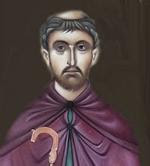
St. Thomas Becket

Today is the optional memorial of St. Thomas Becket, also known as St. Thomas of Canterbury, a 12th century archbishop from England martyred as a result of his strong loyalty to the Church of Rome in opposition to the monarchy of King Henry II.
St. Thomas Becket was born in London, England in 1118. His father was a Norman knight, Gilbert, who had become a prosperous merchant in London; his mother was also Norman, and he had at least two sisters.
Thomas was noted for his piety, his strong devotion to Our Lady, and his generosity to the poor.
He was educated at the Merton Priory in Sussex and at the University of Paris. When he returned to England at twenty-one, he obtained an appointment as a clerk to the sheriff’s court, where he showed great ability. He was determined to make it on his own in the world now that his parents were both deceased.
After three years, he was taken into the household of Theobald, the Norman monk-archbishop of Canterbury. The young Thomas gradually climbed up the ecclesiastical ladder of success via his charm, his generosity and his adaptability. He was ambitious, and refused no opportunity for advancement. He enjoyed having a "good time", but at all times his life was marked by purity and holiness. The archbishop assigned him the post of archdeacon, and, at the age of thirty-six, he was recommended by Theobald to the young King Henry as chancellor.
As his chancellor, Thomas had a personal fondness for Henry and devoted all his efforts to serve and please the young king. Thomas was very well paid for his work and spent his earnings lavishly on entertainment, luxurious clothing, extravagant meals, and on hunting. He never failed to work hard and act prudently on behalf of the king's interests. There is evidence that during this time he was dissatisfied with himself and his "worldly life".
In 1163, Theobald died, and the king secured the election of his friend, Thomas, as archbishop, confident that he would serve all his interests and meet all his demands. Thomas was reluctant to accept the office, and warned Henry that he might regret his decision. Eventually, he did agree to accept the office and when he did, something unusual happened. Thomas suddenly became an austere and very spiritual man, devoting himself wholly to the interests of the Church. He made it clear that he was now the faithful servant of the Holy Father.
A short time later, the inevitable clash with the king occurred. Henry reasserted all the rights of the monarchy, which had been claimed and exercised fifty years earlier. Since that time, however, the papacy had established the claim of the church to control matters such as the trial of clerics and the excommunication of offenders, and had asserted its right to hear appeals and decide all cases.
The archbishop and his king were in constant conflict, and affairs reached a crisis when the king demanded that Thomas agree to the Constitutions of Clarendon (1164. This document stated that all the customs of the past were now contrary to both the law of the Church and the practice of the papacy. Thomas hesitated, and for a moment gave way, thus breaking the solidarity of the bishops in their resistance. Then, at a council at Northampton in 1164 he reasserted his opposition and in face of threats of death or imprisonment, he escaped at night and crossed to France to seek the pope.
As archbishop, Thomas was in exile in France for the next six years, while he and the king and Pope Alexander III attempted to settle the controversy and restore peace to the church in England. Meanwhile Thomas, at the abbey of Pontigny and elsewhere, devoted himself to prayer and penance in what may be called a 'second conversion' from piety to sanctity.
When an uneasy peace was established in 1169, Thomas returned in triumph to Canterbury. Almost immediately, the King enraged by the archbishop's refusal to withdraw some censures, let words slip out that were taken to be a command to kill the archbishop as a traitor.
On December 29th, 1170, four knights from the court of King Henry II burst into Canterbury Cathedral as the Archbishop was on his way to Vespers. Just inside the cloister door, they murdered Thomas Becket, whose defense of the rights of the Church had angered the King. His last words were: 'I accept death for the name of Jesus and for the Church.'
The murder shocked the conscience of all Europe; miracles were announced immediately; the archbishop was canonized as a martyr by Alexander III in 1173; the king did public penance at his tomb, and much of what St Thomas had worked for all his life was accomplished by his death. Within three years, Thomas was canonized, and the shrine of St. Thomas of Canterbury has become one of the most popular destinations for pilgrims from all over the world.
Patron: Clergy; secular clergy; Exeter College Oxford; Portsmouth, England.
Symbols: Sword through a mitre; pallium and archbishop's cross; battle axe and crosier; red chasuble; altar and sword.Often Portrayed As: Archbishop with a wounded head; archbishop holding an inverted sword; archbishop kneeling before his murderers; archbishop being murdered in church.
My Favorite Quotes from St. Thomas Becket:
"Many are needed to plant and water what has been planted now that the faith has spread so far and there are so many people...No matter who plants or waters, God gives no harvest unless what is planted is the faith of Peter and unless he agrees to his teachings."
"Remember the sufferings of Christ, the storms that were weathered...the crown that came from those sufferings which gave new radiance to the faith...All saints give testimony to the truth that without real effort, no one ever wins the crown."
Thomas said this to a friend on his way to ordination: "Hereafter, I want you to tell me, candidly and in secret, what people are saying about me. And if you see anything in me that you regard as a fault, feel free to tell me in private. For from now on, people will talk about me, but not to me. It is dangerous for men in power if no one dares to tell them when they go wrong."
Comments
Post a Comment
Comments are moderated and are published at the blogger's discretion.